My Oracle Support Cloud Portal

With the recent migration to the new Oracle Support portal, many users across the community have experienced significant challenges. Previously favorited knowledge articles are no longer accessible, and several long-standing reference documents cannot be located through search. As a result, user frustration has been growing, with some expressing concern that the transition suffered from inadequate planning and insufficient readiness for go-live.

Oracle has positioned the updated My Oracle Support (MOS) portal as an improved experience, offering several new capabilities, including:

  • AI-powered interactions
  • Streamlined navigation
  • Enhanced search functionality
  • Better knowledge access

To address ongoing concerns, Oracle published an update on December 9 regarding how to find knowledge articles in the new MOS environment. You can review that guidance here:
“Finding knowledge articles in My Oracle – NEWS20”
https://support.oracle.com/support/?kmContentId=11151175&page=sptemplate&sptemplate=km-article

How to find your articles

  • We recommend searching by title or distinctive phrases. Use quotes for exact matches (“Apply Patch 19c”) and add product and version to narrow results (“E-Business Suite 12.2”). Then refine with filters such as product or service and language.
  • Use your browser bookmark or saved URL for the legacy My Oracle Support article. It should redirect to the new article. After it opens, update your browser bookmark and any internal documentation links to the new URL. If the redirect fails, remove any anchor (for example, #section) and try the base article link.
  • If you know the legacy Doc ID (for example, 2118136.2), enter it in search. The results will include items that reference that Doc ID, including the primary article. If the article you need is not in the initial results, click “View more” under Knowledge Results or add a keyword from the title.
  • If needed, use the Top 50 mapping table at the bottom of the page to find the new Article ID, and update any browser bookmarks and internal links to the new article URLs.

Need help?

  • If you cannot locate an article, reach out to Oracle Support by phone or connect with a support agent via My Oracle Support Chatbot.

There is a mapping doc for the top 50 MOS notes.

Some other helpful information listed below.

EBS 12.2 Knowledge ArticleOracle E-Business Suite Release 12.2 Information Center KA729

Visual roadmap that captures Oracle Database Releases – Knowledge Article Release Schedule of Current Database Releases PNEWS1360

PeopleSoft Knowledge Documents – https://docs.oracle.com/cd/E52319_01/infoportal/pdfs/PeopleSoft_MOS_Document_ID_Mappings.pdf

Video guided walkthrough of the new MOS experience –  https://support.oracle.com/knowledgefs/?docId=KA10 My Oracle Support Information Center KA10

Understanding Oracle Fusion Cloud Application Maintenance: Quarterly Updates, Monthly Patching, and Exception Patches Explained.

Oracle Fusion Cloud Applications follow a structured and predictable maintenance model designed to balance innovation, stability, and operational continuity. Understanding the differences between quarterly updates, optional monthly patching, and exception patches is critical for effective planning, testing, and risk management. This article provides a practical overview to help IT and business stakeholders navigate Oracle Fusion maintenance with confidence.

Oracle Fusion Maintenance – Quarterly Updates.

Quarterly updates are mandatory for all Oracle Fusion Cloud environments. These updates deliver cumulative content, including:

  • Bug fixes
  • Security patches
  • New features
  • Functional enhancements

Oracle assigns each environment to a quarterly update cohort, which determines when maintenance occurs.

Quarterly Update Cohorts

  • Cohort A: February, May, August, November
  • Cohort B: March, June, September, December
  • Cohort C: April, July, October, January

Stage environments are patched on the first Friday of the update month, followed by production environments on the third Friday, approximately two weeks later. Cohort alignment is especially important to avoid conflicts with internal freeze periods like month-end, quarter-end, or year-end business cycles.

Quarterly updates follow a standardized naming convention (e.g., 24A, 24B), making it easier to track functional and technical changes over time. Quarterly update names combine the year and A, B, C or D. For example, the release for the first quarter of 2023 is 23A; the release for the second quarter of 2023 is 23B; and the release for the first quarter of 2024 will be 24A.


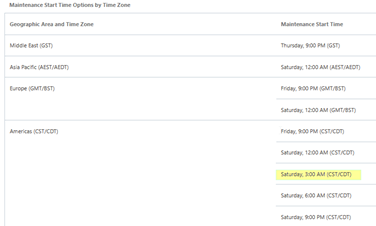
Maintenance start time – Start times are available for the following geographic areas.


Monthly Maintenance Patching: Optional Bug Fixes Between Quarters

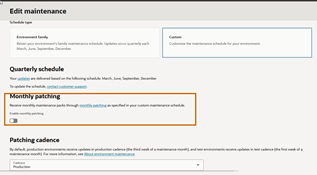
Monthly maintenance packs are optional and deliver bug fixes only, they do not include new features or enhancements. Quarterly updates already contain cumulative fixes. Therefore, monthly patching is disabled by default. It can be enabled in the console if needed under the Edit Maintenance section.

Once enabled, the patches will continue to be delivered each month until Monthly Patching is turned off. Please note that Monthly Patching can be enabled or disabled up to 10 days before the first Friday of the month in which you want the monthly maintenance cycle to start or stop.  Once enabled, Patching is not on demand, it will align with the standard monthly cadence: 1st Friday of the month for stage, 3rd Friday of the month for Production

Oracle recommends enabling monthly patching only when absolutely necessary, like when critical defects can’t wait until the next quarterly update.

Key considerations include:

  • Additional planned outages
  • Increased testing and coordination effort
  • Potential impact to environment refresh schedules
  • Fixed cadence (patching is not on demand)

Exception Patches: Targeted Fixes for Critical Issues

Besides quarterly updates and monthly maintenance packs, Oracle provides Fusion Exception Patches for critical or high-impact issues that require immediate remediation.

Exception patches are:

  • Issued outside the standard quarterly or monthly maintenance cycle
  • Targeted and issue-specific, addressing a defined defect or risk
  • Typically applied only when Oracle determines the issue is severe, like data corruption, security vulnerabilities, or significant business disruption

Unlike monthly patching, exception patches are:

  • Not customer-initiated or scheduled on demand
  • Delivered at Oracle’s discretion after validation and approval
  • Often applied during a separate, Oracle-coordinated maintenance window

Because exception patches fall outside the regular cadence, they may require:

  • Expedited testing
  • Additional stakeholder communication
  • Close coordination between Oracle Support and customer IT teams

Exception patches are generally documented through Oracle Support (SRs and KB notes) and may later be included in a future quarterly update as part of cumulative fixes.


Maintenance Timing and Notifications

Oracle provides automated email notifications to ensure customers are informed about all maintenance-related activities, including:

  • 30 days before maintenance
  • 7 days before maintenance
  • Completion of maintenance
  • Any extensions, rescheduling, or cancellations

For customers in the Americas region, maintenance typically begins at 3:00 AM CST, minimizing business impact while maintaining consistency.


Environment Refresh Rules and Restrictions

Oracle enforces strict rules around environment refreshes to protect system integrity:

  • Source and target environments must be on the same patch level
  • A target environment can only be refreshed once every 7 days
  • Refreshes are restricted:
    • Within 5 days before maintenance
    • 1 day after maintenance begins
    • Between environments with different maintenance dates
  • Maintenance policy changes are restricted 10 days before maintenance

Enabling monthly patching or applying exception patches may further limit available refresh windows, requiring rescheduling of planned activities.


Functional Freeze Before Maintenance

Seventy-two hours prior to maintenance, Oracle restricts updates to certain predefined setup data. During this period, users attempting restricted changes will receive a message indicating that predefined data cannot be updated during application maintenance. This functional freeze ensures a stable baseline for maintenance execution.


Planning for Success

Successfully managing Oracle Fusion maintenance requires coordination across IT, business, and Oracle Support. Best practices include:

  • Selecting the appropriate quarterly cohort to align with business calendars
  • Limiting monthly patching to high-need scenarios
  • Understanding the role and impact of exception patches
  • Planning testing cycles around stage and production timelines
  • Accounting for refresh and functional freeze restrictions

By proactively managing quarterly updates, monthly patching, and exception patches, organizations can minimize risk, maintain system stability, and fully leverage the ongoing innovation delivered through Oracle Fusion Cloud Applications.


Reference documents:

Understanding Environment Maintenance – https://docs.oracle.com/en-us/iaas/Content/fusion-applications/plan-environment-family.htm#about-env-maintenance

Oracle Fusion Cloud Applications Suite Known Issues and Maintenance Packs KB170336

Oracle Applications Cloud – Fusion Applications Update Policy KB160632

Useful Blogs:

Oracle EBS Zero-Day Vulnerabilities: What You Need to Know About Recent CVE’s

Oracle issued two critical vulnerabilities in September 2025, CVE-2025-61882 and CVE-2025-61884. Affecting Oracle E-Business Suite (EBS). These vulnerabilities have been actively exploited in the wild, impacting organizations such as Harvard University and American Airlines’ subsidiary, Envoy Air.

CVE-2025-61882 may impact BI/Analytics Publisher functionality.
CVE-2025-61884 can be mitigated further by disabling Oracle Configurator if unused.

Mitigation:
Refer to MOS documents 3106344.1 and 3107176.1 for detailed patching and mitigation steps.

Risk Assessment:
While both vulnerabilities are critical, environments not exposed externally have a reduced immediate risk. Nevertheless, the recent breaches highlight the importance of timely patching and vigilant monitoring.

Threat Actor:
The Cl0p ransomware group has claimed responsibility for exploiting these vulnerabilities, leading to data breaches at several organizations. For instance, over 1.3 TB of data allegedly stolen from Harvard was posted on the Cl0p data leak website

Summary of the Oracle EBS patches and mitigations for CVE-2025-61882 and CVE-2025-61884.


CVE-2025-61882 – Oracle EBS
Affected Releases: 12.1.3, 12.2

Release 12.2:

  • Apply Patch 38501230:R12.TXK.C and Patch 38501349:R12.CAC.C (hotpatch mode).
  • Stop and restart Oracle EBS.
  • Apply Patch 38501757:R12.XDO.C (hotpatch mode).
  • If ojspCompile.pl errors occur, apply Patch 38502365:R12.TXK.C (hotpatch mode).

Release 12.1.3:

  • Apply Patch 38501376:R12.TXK.B and Patch 38501349:R12.CAC.B (hotpatch mode).
  • Stop and restart Oracle EBS.
  • Apply Patch 38501757:R12.XDO.B (hotpatch mode).

Note: BI/Analytics Publisher functionality (create, copy, preview templates) will be impacted.

Workaround: Use “Moving Templates and Data Definitions Between E-Business Suite Instances” in the Oracle XML Publisher guide. https://docs.oracle.com/cd/B34956_01/current/acrobat/120xdoig.pdf

CVE-2025-61884 – Oracle EBS
Affected Releases: 12.1.3, 12.2

Release 12.2:

  • Apply Patch 38512809:R12.CZ.C and Patch 37614922:R12.IES.C.

Release 12.1.3:

  • Apply Patch 38512809:R12.CZ.B and Patch 37614922:R12.IES.B.

Optional Mitigation:

Disable Oracle Configurator if not in use:

Perform the following steps using the Functional Administrator responsibility:

  1. Go to the Management by Product Hierarchy tab.
  2. In the left panel under the Order Management & Logistics product family, click Configurator.
  3. In the right panel under the Details region, deselect the Enable checkbox.
  4. Click Apply.