
Monthly Maintenance Patching in Oracle Fusion: A DBA‑Focused Overview
Monthly maintenance patching is Oracle’s mandatory security and stability cycle for all Fusion SaaS environments, introduced globally in June 2026. This patching program ensures that every customer tenant across ERP, HCM, SCM, and CX receives consistent updates that strengthen security posture, maintain infrastructure health, and align environments for quarterly functional releases.
1. What Monthly Maintenance Entails
It delivers a consolidated set of updates across the entire stack, including security vulnerability fixes, infrastructure hardening, middleware updates, and application‑level enhancements. These patches address zero‑day threats, cloud platform vulnerabilities, performance issues, and configuration drift that naturally occurs in a multi‑tenant environment. Oracle also applies telemetry‑driven fixes based on global error patterns and SR trends, ensuring that recurring issues are resolved proactively.
This maintenance window includes downtime for both non‑production and production environments, along with enforced blackout periods that prevent refreshes from interfering with patch deployment. Because Fusion environments operate in cohorts, monthly maintenance also helps maintain alignment across environments, reducing the risk of inconsistent behavior between DEV, TEST, and PROD.
What this means for your environment(s):
- There is no change to the Fusion Applications Quarterly Update schedule.
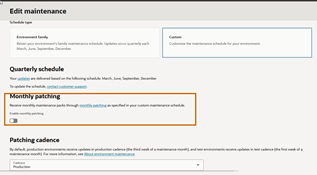
- If you previously opted in to monthly maintenance, your maintenance schedule on your production environments doesn’t change. However, as of June 2026, you’ll have a second monthly downtime on your non-production environments for maintenance.
- If you previously opted out of monthly maintenance, you’ll be scheduled for mandatory monthly maintenance starting in June 2026.
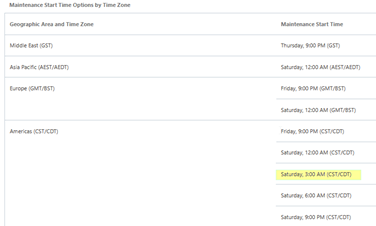
- All environments on a production schedule will receive mandatory monthly maintenance on the weekend of the third Friday of the month, except in Middle East regions, which will receive mandatory monthly maintenance on the third Thursday of the month.
- All environments on a non-production schedule will receive mandatory monthly maintenance during the week of the third Friday of the month.
- You’ll receive prior notice before any scheduled downtime, allowing you to plan your activities / refreshes accordingly.
- If a scheduled refresh conflicts with planned maintenance, Oracle will cancel the refresh to accommodate mandatory monthly maintenance. You’ll need to reschedule the refresh once the mandatory maintenance is complete.
- Oracle may modify the mandatory monthly maintenance schedule or discontinue monthly maintenance in order to best meet customer needs.
2. Deployment Plan and Operational Impact
Oracle follows a predictable deployment plan: non‑production environments are patched first, followed by production environments. Downtime windows are fixed and cannot be rescheduled, and Oracle typically sends notifications about a week in advance. During the maintenance cycle, refresh blackout periods are enforced to prevent data corruption, cohort misalignment, and patch incompatibility.
For DBAs, this means planning around downtime, adjusting refresh calendars, monitoring integrations after maintenance, and validating environment stability. Monthly maintenance also interacts with weekly patching and quarterly updates, forming a layered patching rhythm. The monthly cycle ensures the platform is secure enough to support quarterly functional updates without introducing instability.
3. Regression Testing Expectations and Final Recommendations
Regression testing is not mandated by Oracle, but it is strongly recommended for any environment with custom roles, complex integrations, or critical business flows. Monthly maintenance can introduce subtle changes in workflows, security policies, integration latency, and backend configurations. Running targeted regression tests such as validating core business flows, checking integration behavior, confirming security role functionality, and reviewing scheduled jobs helps ensure stability after patching.
From a DBA perspective, the best practice is to treat monthly maintenance as a strategic security event rather than a routine patch. Maintain a refresh calendar aligned with blackout windows, document cohort alignment, monitor integrations closely, and run smoke tests within 24 hours of patch completion. This approach ensures your Fusion environment remains secure, compliant, and operationally predictable.
Additional Information
- Oracle SaaS Change Management Information
- Applications Security
- Oracle Fusion Applications Cloud Suite Maintenance Pack Documentation (KB157616)