
Leveraging Artificial Intelligence to Improve IT Operations and Organizational Performance

Ramesh Ganesan

April 24, 2026

Abstract

The concept of Artificial Intelligence (AI) is quickly transforming how organizations manage their information technology (IT) operations and overall business performance. While AI offers significant potential, many organizations face challenges such as fragmented implementation, lack of strategic alignment, inadequate data infrastructure, and resistance to change. These barriers often limit the success and return on investment of AI initiatives.

This paper explores how AI technologies, including machine learning, predictive analytics, and automation, can be strategically implemented in IT operations to improve efficiency, enhance decision-making, and strengthen overall organizational performance. The study is based on academic sources and best practices in the industry and proposes a structured framework emphasizing alignment between technology, data, and organizational strategy.

In addition, the paper stipulates the key performance indicators (KPIs) to measure the efficiency of implementing AI and a step-by-step implementation roadmap to help organizations navigate the implementation process. The results indicate that companies that effectively embrace AI in their IT systems can attain productivity, lower operations expenses, increase agility, and sustain competitive advantage in a more digital and data-intensive business world.

Table of Contents

Introduction

Artificial Intelligence (AI) is one of the emerging technologies that is rapidly transforming today’s organizational landscape. Applications such as predictive analytics, machine learning, automation, and cloud-based AI platforms are expanding quickly, and they are expected to streamline operational processes, support better decision-making, and improve overall productivity. Oracle, Amazon, Microsoft, Meta and Google are major tech companies that are spending hundreds of billions of dollars to create the infrastructure of the future of AI. Subsequently, companies that embrace AI can enhance efficiency, productivity and innovation by a significant margin, and in the end, competitive advantage. Ali et al. (2024) examines how Amazon Web Services (AWS) can stimulate AI-driven innovation and improve the performance of the corporate in Pakistani industries. The source is helpful in the sense that it provides empirical evidence of the implementation of AI technologies into actual practice that contributes to the increased organizational performance and innovation, especially in the developing economies.

AI is a key component of digital transformation, as it allows optimization of operations, increases customer experience, and allows responding to varying market conditions more quickly. There are numerous limitations to the successful execution of AI in many organizations since it is perceived as a difficult task because of inadequate expertise, poor data infrastructure, and resistance to change. The absence of a clear plan makes it likely that AI initiatives will be disjointed and ineffective and yield poor results. Because of these challenges, many organizations cannot fully use AI to improve performance and IT efficiency. AI technologies increase productivity, promote innovation, and allow organizations to remain in the competitive niche of their industries when properly incorporated into the business processes (Brynjolfsson & McAfee, 2017).

Babatunde et al. (2026) examines the relationship between AI adoption, innovation management, and organizational performance. The study shows that organizations that strategically use AI within their innovation processes tend to achieve greater agility and improved performance outcomes. Organizational agility is highlighted as a key mediating factor, enabling firms to respond quickly to technological changes. This source supports my project by emphasizing both the strategic importance of adoption of AI and the role of agility in maximizing its benefits.

Additionally, through case studies of early adopters, (Davenport & Ronanki, 2018) demonstrate that companies often gain the most value from AI by improving existing processes rather than attempting complete transformation. This article contributes a practical perspective by complementing the Resource-Based View with real-world applications. It also introduces three main categories of AI as process automation, cognitive insight, and cognitive engagement, which provide a useful framework for organizing and evaluating AI use cases.

This research aims to explore how organizations can leverage AI technologies to enhance IT operations and overall performance. By reviewing academic literature, industry best practices, and AI implementation frameworks, the study seeks to identify key strategies for successfully integrating AI into IT infrastructure and operational processes. The findings are expected to offer practical insights for organizational leaders on adopting AI in a responsible, effective, and sustainable way while maximizing its impact on operational efficiency and strategic performance.

Hypothesis

H1: Organizations that adopt a structured and strategically aligned approach to integrating Artificial Intelligence (AI) into IT operations supported by strong data infrastructure, workforce readiness, and effective management will achieve higher operational efficiency, improved employee productivity, and better overall organizational performance compared to organizations with uncoordinated AI adoption.

This hypothesis is supported by existing literature that emphasizes the importance of strategic alignment, data infrastructure, and organizational readiness in successful AI implementation.

Research Question

This study examines how a structured and strategically aligned approach to Artificial Intelligence (AI) adoption can improve IT operational efficiency and overall organizational performance. To examine this hypothesis, the study is guided by three key research questions:

  1. RQ1: How does the adoption of Artificial Intelligence (AI) impact IT operational efficiency in organizations?
  2. RQ2: What is the relationship between AI implementation and overall organizational performance?
  3. RQ3: What are the key challenges affecting the successful integration of AI in IT operations?

Existing research identifies AI as a transformative technology that enables organizations to process large volumes of data, automate repetitive tasks, and generate predictive insights, thereby improving decision-making and driving digital transformation. Although AI adoption is expanding across organizations of all sizes, its success is not guaranteed. Key challenges include the absence of a clear strategic framework, inadequate data infrastructure and quality, a shortage of skilled professionals, barriers to change, along with ethical issues such as data privacy and algorithmic bias.

Overall, the literature suggests that organizations that address both technological and human factors through a coordinated and strategic approach are more likely to realize the full benefits of AI implementation.

Literature Review

Organizational and Technological Background

Artificial Intelligence (AI) is evolving incredibly fast and turns out to be one of the main factors of organizational change. In relation to RQ1, studies show that AI improves IT efficiency, improves IT processes and facilitates strategic decision-making. The application of AI in business is strictly connected with the global phenomenon of digital transformation, which entails engaging in the use of advanced technologies to radically transform the functioning of organizations and the value generation (Chen et al., 2022).

In the past, organizations used to use traditional IT systems whereby most were reactive and hence had to be manually operated in terms of checking, servicing and decision making. The traditional approaches are however not enough in the light of the exponential growth of data and the growing complexity of business environments. The current AI technologies help organizations shift towards proactive and predictive models of operation, which are much more efficient and performance-oriented (Davenport & Ronanki, 2018).

The increased significance of cloud computing, the Internet of Things (IoT), and big data analytics also affect AI adoption. These technologies provide the necessary infrastructure for AI systems to collect, process, and analyze large volumes of data in real time. Due to this fact, organizations are able to get a better understanding of their operations and be able to make better decisions.

Evolution of AI in Organizations

The adoption of AI in organizations has progressed through several major inflection points. In the early 2000s, automation was primarily driven by rule-based systems and basic tools designed to handle repetitive tasks. During the years 2000 to 2010, the emergence of the big data era enabled organizations to leverage data analytics and business intelligence to support more informed decision-making.

From around 2015 to the present, there has been a significant expansion of AI and machine learning, with advanced algorithms increasingly integrated into enterprise systems to enhance efficiency and performance. More recently, in the 2020’s, the rise of generative AI and cloud-based AI platforms has further accelerated adoption by making AI technologies more scalable, accessible, and easier to deploy across organizations.

As highlighted by Davenport and Ronanki (2018), early AI adoption focused primarily on process automation. However, contemporary applications extend to cognitive insights and customer engagement, reflecting a shift toward strategic integration.

Role of AI in Digital Transformation

AI has become a core component of digital transformation, enabling organizations to automate routine IT tasks, improve system reliability, strengthen cybersecurity through anomaly detection, and support real-time decision-making. As highlighted by Chen et al. (2022), AI capabilities on spanning data, technology, and human expertise to act as strategic assets that enhance overall firm performance.

Current State of Artificial Intelligence Research

AI and IT Operations

In relation to RQ1, studies show that AI significantly improves IT operational efficiency through automation, predictive analytics, and real-time monitoring. Use of AI in IT operations is referred to as AIOps (Artificial Intelligence for IT Operations) and application of AI in IT operations has received significant attention during the past few years. A machine learning and data analytics-powered practice of automating and optimizing IT processes, including system monitoring, incidence management, and performance optimization, is known as AIOps.

According to Davenport and Ronanki (2018), there are three main categories of AI applications in the organizations, which include process automation, cognitive insight, and cognitive engagement. The idea behind process automation is to automate repetitive processes using AI to reduce the human factor involved and minimize the number of errors. Cognitive insight is the act of processing large amounts of data to make actionable insights and the act of cognitive engagement where AI can be utilized to offer user interaction through chatbots and virtual assistants among other technologies.

These capabilities are leveraged to improve the speed and stability of IT systems with AIOps solutions. To give an example, any anomalies in the performance of the system, potential failures, and proposing any corrective actions can be predicted with the assistance of AI. It is an offensive approach that reduces downtimes, enhances system reliability and, by the large, boosts service delivery.

AI and Organizational Performance

In relation to RQ2, existing literature highlights that AI adoption has a strong positive impact on overall organizational performance, including productivity, innovation, and competitive advantage. Kassa & Worku (2025) discovered that the use of AI positively impacts the productivity of employees with a significant effect on the overall performance of an organization. The Resource-Based View (RBV) theory can be used to get a better perspective on the role of AI in creating a competitive advantage. The authors state that the implementation of AI depends on the importance of AI capability, which includes tangible resources (technology infrastructure), the intangible resources (organizational culture and processes), and human skills (Chen et al., 2022).

Companies that manage to build such capabilities are more likely to use AI to become more successful. Moreover, AI facilitates innovation because it helps organizations design new products, services, and business models. As Keicher et al. (2022) explain, AI is not a single tool but a group of technologies including machine learning, data analytics, and natural language processing that can be strategically used to improve idea generation, development, and implementation.

AI and Innovation

Innovation in contemporary organizations is one of the leading elements of AI. AI helps to create a new product, service, and business model by allowing the analysis of big data and automating complex processes. According to Keicher et al. (2022), AI can improve innovation because it aids various steps in the innovation process. As an illustration, AI can be employed to process customer information and detect new market possibilities, have new ideas about new products, and streamline the development process.

Wang et al. (2026) also show that organizational learning based on AI leads to sustainable performance through the establishment of continuous improvement and innovation. Organizations that use AI in learning and knowledge sharing will be in a better position to adopt the changing market conditions and be able to stay ahead of the market.

AI and Decision Making

Among the key advantages of AI, we can distinguish the possibility to improve decision-making. In the traditional methodology of decision making, human judgment is usually involved in the process, and it may be affected by biases and lack of information. Instead, AI helps business organizations process vast amounts of data and produce insights that can help them make more informed and objective decisions.

Sahay and Kaur (2021) highlight that performance management can be improved through AI-based decision-making systems that provide real-time data analysis and forecasting. These systems help managers identify trends, evaluate performance, and make more informed strategic decisions.

Besides that, AI helps in predictive analytics, which enables organizations to produce future results depending on past records. This feature is especially useful in the sphere of IT operation as predictive maintenance can be used to avoid system failures and minimize downtime. Organizations can achieve efficiency and minimize operational risks by moving towards predictive decision making over reactive decision making.

Common Obstacles to AI Implementation

Organizational Culture Challenges in AI Adoption

Cultural and organizational factors significantly influence AI implementation, with key challenges including resistance to change, data security concerns and costs, and a lack of digital leadership (Madanchian & Taherdoost, 2025). The implementation of AI is not just a technological issue but also a cultural one. The implementation of AI will involve a change in organizational culture, such as the work practices and the decisions, as well as the roles of employees.

Murire (2024) notes that AI is reshaping the organizational culture through recreating the ways in which employees relate with technology and decision-making. In order to successfully integrate AI, organizations should be able to foster a culture that prompts innovation, lifelong learning, and collaboration.

The complexity of AI technologies creates a major challenge for organizations. These systems require specialized expertise in areas like machine learning and data analytics, which makes them harder to implement and manage effectively. As a result, many organizations struggle to hire and retain skilled professionals, which limits their ability to successfully deploy AI solutions. To address this issue, training and development play a critical role. Organizations must invest in building employee capabilities so they can work effectively with AI technologies. This includes not only technical skills but also an understanding of how AI can be applied to improve performance and support organizational goals.

Resistance to change is another vital hindrance to the implementation of AI within the organization. Employees are also likely to be reluctant to use new technologies because they are afraid of being displaced or are not aware. Such resistance may delay implementation processes and lower the efficiency of AI programs.

Technical Challenges in AI Adoption

In relation to RQ3, several studies identify key challenges affecting the successful implementation of AI, particularly from a technical perspective. One of the main challenges is the lack of proper data infrastructure. AI systems rely heavily on high-quality data, and organizations with weak data management practices often struggle to adopt effective AI solutions (Murire, 2024). Without reliable and well-organized data, AI technologies cannot deliver accurate or meaningful results.

In addition, data management issues continue to be a major concern. Poor data quality and fragmented systems can reduce the performance of AI applications and limit their impact on IT operations. As emphasized by Michael et al. (2024), organizations, especially in the public sector, also face challenges related to limited resources, bureaucratic constraints, and technological barriers, which can further complicate AI adoption. These issues highlight the importance of having strong technical foundations in place to successfully implement AI solutions.

Ethical and Risk Challenges

Ethical and risk concerns are also important issues in the use of AI. The privacy of data, the bias of the algorithm, or transparency are some of the issues that should be addressed with caution to have responsible utilization of AI technologies.

Correa et al. (2023) identify key ethical challenges in AI, including privacy, algorithmic bias, transparency, and explainability. Their review of over 200 governance frameworks shows that while some common principles exist, AI regulation is not yet standardized. As a result, organizations must establish proper governance and promote responsible AI use to avoid reputational damage and potential regulatory penalties.

As Murire (2024) points out, ethical issues may influence employee trust and the reputation of an organization. To make sure that the AI systems are used in an ethical and transparent way, organizations should introduce a set of governance mechanisms.

Besides this, the question of cybersecurity risks of AI systems should be resolved. As companies grow to be dependent on AI to carry on critical business processes, it increases the risk of the overall weaknesses of the system or cyberattacks.

Competition and the Industry

AI has introduced competition into this industry as companies grapple with how to use technology to achieve a competitive advantage. Learning to use AI will help companies make faster decisions and offer a better service to their customers, while being more efficient and cost-effective. However, it aims to overburden the market by creating AI. It is therefore noteworthy that companies ought to engage in strategic differentiation and relentless innovation. Babatunde et al. (2026) also note, one of the criteria for competitiveness in such an environment is that an organization be agile.

The other industry that will be affected by AI is already underway, with new forms of business launched alongside old processes being ripped out. AI is also aimed at improving resource allocation, human resource planning, and government efficiency, among other things (Michael et al., 2024).

Summary of Literature

The reviewed literature shows that AI can make a major impact on enhancing IT operation and organizational performance. AI can improve efficiency, facilitate innovation, and make decisions based on data. Nonetheless, the challenges to be overcome to achieve successful implementation are concerned with the issues of data infrastructure, skills, organizational culture, and ethical concerns.

Overall, the literature suggests that taking a strategic approach to implementing AI in IT operations can improve both operational efficiency and overall organizational performance (RQ1 and RQ2). At the same time, it also shows that there are several challenges, such as poor data infrastructure, lack of skilled employees, and resistance to change, that can affect successful adoption (RQ3). Because of these challenges, there is a clear need for a more structured approach to help organizations effectively implement and scale AI.

Research Problem and Research Gap

Although artificial intelligence (AI) has strong potential to improve IT operations and organizational performance, many organizations struggle to fully implement it effectively. The main problem is that AI adoption is often fragmented due to poor data infrastructure, lack of skilled professionals, resistance to change, and weak alignment with business strategy. The research gap exists between what theory suggests about the benefits of AI and how it is applied in practice. While existing studies highlight AI’s advantages, they do not fully address how organizations can overcome real-world challenges in a coordinated and practical way. This creates a need for research that focuses on developing a more integrated and strategic approach to successful AI implementation.

Proposed Solution Summary

This study proposes a structured and strategic framework for integrating Artificial Intelligence (AI) into IT operations to address the identified research questions. In response to RQ1, the framework emphasizes the use of AI-driven automation, predictive analytics, and AIOps tools to enhance IT operational efficiency and reduce system downtime. Addressing RQ2, the solution highlights how AI capabilities can improve organizational performance by increasing productivity, enabling data-driven decision-making, and fostering innovation. In relation to RQ3, the framework incorporates key enablers such as robust data infrastructure, workforce skill development, and change management strategies to overcome common challenges in AI adoption. Overall, the proposed approach provides organizations with a comprehensive roadmap to successfully implement AI and achieve sustainable performance improvements.

The findings of this study support the hypothesis that organizations adopting a structured and strategic approach to AI integration are more likely to achieve improved operational efficiency and organizational performance.

Key Performance Indicators (KPIs)

A well-developed performance, effectiveness, and impact measurement framework is necessary to successfully introduce Artificial Intelligence (AI) into IT operations. Key Performance Indicators (KPIs) are essential in determining whether AI-based projects have met their desired goals, such as efficiency, cost saving, decision-making, and performance of the organization. As the organizations leave the traditional IT-based systems and develop AI-driven environments, they need to implement measurable indicators that will correspond to the strategic objectives and operational priorities.

The AI technologies allow organizations to transform reactive operations into proactive and predictive modes of operations. Thus, KPIs should also be able to quantify the present performance, as well as reflect the change in the forecasting, automation, and intelligence of the system. The section describes major KPIs in four critical dimensions, including operational performance, financial performance, strategic impact, and innovation and learning.

Operational Performance KPIs

Operational performance KPIs measure the effectiveness of AI in improving IT processes, system reliability, and service delivery.

Reduction in IT Downtime

Minimization of system downtime can be considered as one of the main goals of AI implementation in IT operations. Predictive analytics based on AI can help prevent system failures by detecting them before they happen and perform maintenance proactively.

It is reasonable to expect that within the first year of implementation, organizations that use AI-based monitoring systems will experience a 30 to 40 percent decrease in unplanned downtime (Davenport & Ronanki, 2018). Less downtime means better service availability, as well as improved user experience.

Mean Time to Resolution (MTTR)

Mean Time to Resolution (MTTR) is the average time that it takes to resolve IT incidents. The AI-based systems can minimize MTTR by automating the processes of detecting, diagnosing, and resolving incidents. Machine learning algorithms analyze historical incident data to identify patterns, predict root causes, and recommend optimal solutions, thereby improving operational efficiency and accelerating service recovery. For example, AIOps implementations have been shown to reduce MTTR by approximately 40% (Shah & Divecha, 2025).  This results in improved operational efficiency and faster recovery of service.

Mean Time Between Failures (MTBF)

MTBF (Mean Time Between Failures) measures system reliability by calculating the average time between system failures. AI improves MTBF by enabling predictive maintenance and early detection of anomalies. By identifying patterns and potential risks, AI systems can prevent failures, leading to increased system stability and reliability.

Automation Rate

Automation rate is a percentage of the IT processes automated with AI technologies like Robotic Process Automation (RPA). Companies that implement AI can automate up to 40-60 percent of the IT system repetitive processes, eliminating human workload and decreasing the number of errors (Sahay and Kaur, 2021). The increased amount of automation helps to achieve better efficiency and cost-saving.  AI technologies, machine learning, and big data analytics can be applied to enhance an organization’s performance. The research focuses on aspects of AI used for performance assessment, automation, and objective employee evaluations based on real-time data analysis. According to research, AI will help managers make better decisions and enhance performance management systems. The source is helpful for the project because it focuses on the performance measurement and management of companies using AI.

Financial Performance KPIs

Financial KPIs evaluate the economic impact of AI implementation, including cost savings and return on investment.

Cost Reduction in IT Operations

Automation and predictive maintenance powered by AI can significantly reduce operational costs by minimizing downtime, reducing manual labor, and optimizing resource allocation. According to WorkTrek (2025), predictive maintenance can reduce maintenance costs by approximately 18–25%, while AI-driven optimization can lower operational and infrastructure costs by 20–30% through improved resource utilization and automation. These cost savings are achieved through reduced maintenance expenses, lower labor requirements, and improved overall system efficiency.

Return on Investment (ROI)

ROI is an important measure of financial feasibility of AI projects. It quantifies the difference between the gains and the expenses that have been incurred. The positive ROI of AI is normally realized in 12-18 months of implementation according to the scale and complexity of the project (Chen et al., 2022) in his article shows that artificial intelligence (AI) influences firm performance through the lens of the resource-based view (RBV), focusing specifically on e-commerce firms. The study introduces the concept of artificial intelligence capability (AIC), which is composed of three key dimensions: tangible resources (basic), intangible resources (proclivity), and human skills.

Cost of Incident Management

AI reduces the cost associated with IT incidents by enabling early detection and automated resolution. Lower incident frequency and faster resolution times contribute to significant cost savings.

Strategic Performance KPIs

Strategic KPIs measure the broader impact of AI on organizational performance, decision-making, and competitive advantage.

Decision-Making Speed

AI allows organizations to analyze data in real time, enabling them to make faster and more informed decisions. The AI based analytics can enhance the speed of decision-making by 25-40% (Kassa & Worku, 2025). Increased agility and responsiveness to changes in the market are contributed to by faster decision-making.

Employee Productivity

AI can improve the productivity of employees by performing mundane tasks automatically and offering decision support systems. The staff can concentrate on the activities that are of higher value, hence enhancing performance. It has been shown that productivity can be enhanced by 20-25 percent with the adoption of AI (Kassa & Worku, 2025).

Customer Experience and Satisfaction

AI-driven IT operations improve service reliability and response times, leading to enhanced customer satisfaction. By enabling faster decision-making, real-time analytics, and improved service delivery, AI contributes to better customer experiences and organizational performance (Davenport & Ronanki, 2018; Sahay & Kaur, 2021; Chen et al., 2022). Metrics such as Net Promoter Score (NPS) and customer satisfaction scores can be used to measure this impact.

Organizational Agility

Organizational agility refers to the ability to respond quickly to changes in the business environment. AI enhances agility by enabling real-time insights and predictive capabilities. Organizations with strong AI capabilities are better equipped to adapt to market changes and maintain a competitive advantage.

Innovation and Learning KPIs

AI not only improves operational efficiency but also supports innovation and organizational learning by enabling data-driven insights, continuous improvement, and knowledge creation within organizations (Keicher et al., 2022; Wang et al., 2026; Murire, 2024).

Rate of Innovation

The AI can be used to create new products, services, and business models in the organization. Innovation rate could be quantified through the number of new initiatives, new products or improvements in processes that are led by AI.

AI Adoption Rate

This KPI is used to track the level of AI technologies integration in organizational processes. Increase in adoption rate is a sign of successful adoption and cultural acceptance.

Employee Skill Development

The use of AI demands life-long learning and upgrading. To monitor the preparation of the workforce, organizations ought to monitor training attendance and the level of acquisition of the skills.

Risk and Compliance KPIs

Implementation of AI brings new risks which need to be handled efficiently.

Data Security and Privacy Compliance

Companies need to be in line with the data protection laws. The KPIs can be the number of security incidents, compliance audit results and the frequency of data breaches.

Algorithm Accuracy and Bias Reduction

The AI systems should be precise and objective. To have ethical AI use, organizations need to quantify the accuracy of models, errors, and measures of fairness.

Integrated KPI Framework

To achieve a successful assessment, organizations are supposed to implement a comprehensive KPI system that integrates operational, financial, and strategic measurements. This will guarantee comprehensive evaluation of AI performance. The constant monitoring and reporting of KPIs will allow organizations to see what they can do better and optimize AI systems with time. It is necessary to continuously review the efforts of AI to make sure that it is directed toward the organizational objectives.

Summary of KPIs

The adoption of AI in IT functions must have a scale of KPIs that are clear and complete to quantify achievement. Operational KPIs are concerned with efficiency and system performance, financial KPIs are concerned with cost savings and ROI, strategic KPIs with impact of organizations and innovation KPIs with long-term growth and learning.

Overall, KPIs offer a systematic method of reviewing the performance of AI projects and guaranteeing steady enhancement. With the help of the alignment of KPIs with the strategic goals, organizations will be able to make the most of AI and attain sustainable performance changes.

Implementation Timeline

Phase 1: Planning and Strategy Development (Months 1–2)

The first stage is concerned with laying a strategic ground to adapt AI into IT operations. A thorough analysis of current IT infrastructure, data capabilities, and work processes done by organizations is necessary to estimate gaps and preparedness to integrate AI. At this phase, there are objectives that must be articulated in line with business objectives, and these are, improving efficiency, reducing downtime, and improving decision-making. Also, companies need to pinpoint AI to use cases that add value, allocate funds, and develop governance frameworks to monitor the implementation. This stage should be characterized by intense leadership support and alignment among the stakeholders to deliver a coherent strategic path and implementation.

Phase 2: Pilot Testing (Months 3–4)

The pilot testing stage will mean the implementation of AI solutions in a controlled setting to determine their effectiveness prior to their full-scale execution. A high-quality data is essential to effective AI performance, and relevant data must be prepared and cleaned in organizations. The useful AI models, such as predictive analytics and automated monitoring systems, are being implemented in select IT functions to evaluate their potential. Close monitoring of performance and collection of user and stakeholder feedback is done during this stage. It is aimed at finding out the technical problems, determining feasibility, and improving the system so that there are reliability and compliance with the needs of the organization.

Phase 3: Deployment (Months 5–7)

During this stage, AI solutions are implemented throughout IT operations of the organization after the pilot testing is successful. It is about the incorporation of AI systems into the existing IT infrastructure, such as enterprise platforms and data systems, to make it work seamlessly. Training and change management programs to the employees are essential at this point so that it can be easily adopted and resistance is reduced. Companies should also convey the advantages of AI in a simple way to achieve acceptance and involvement. This is the stage of experimental application to full operational implementation where AI starts to bring quantifiable value.

Phase 4: Monitoring and Evaluation (Months 8–10)

Monitoring stage is devoted to the assessment of the performance and the effect of AI implementation with the help of set Key Performance Indicators (KPIs). Some of the measures that organizations should constantly monitor include the performance of the systems, reduction of downtime, reduction of cost, and better productivity. The accuracy of systems and user satisfaction should be checked by evaluating both quantitative and qualitative data provided by the employees. Periodic performance reviews help detect loopholes and weaknesses and make improvements, which makes the AI systems movable according to organizational aims and provide the desired results.

Phase 5: Optimization and Continuous Improvement (Ongoing)

The final step is concerned with the additional regeneration and the extended optimization of AI systems. It is significant that companies should optimize the AI models based on the performance data and enhance the activities of the system and expand AI to other areas of IT operation. Constant learning, skills development of the employees, and adaptation to the new technologies are necessary to stay with the AI-driven transformation. This step will ensure that AI implementation will be dynamic, scalable, and business need-oriented, which in the long run will lead to competitive advantage and organizational development.

Conclusion

Artificial Intelligence (AI) is a disruptive technology that may influence the work of IT processes and the whole organization’s performance significantly. The ability to employ AI potentials such as machine learning, predictive analytics, and automation has become one of the most significant success elements as organizations keep operating in increasingly complex and data-driven environments. It has been demonstrated in this paper that AI can make operations more efficient, faster and more accurate in decision making, and reduce costs through automation and prediction.

The outcomes of the research also show that efficient implementation of AI cannot be done by technology alone, but it is also based on the strategic, structured, and organization-wide approach. Such problems as inappropriate data infrastructure, technical competencies and an unwilling attitude to change must be managed carefully to make integration successful. A successful organization in AI projects must make sure that it aligns business objectives with AI projects, invests in data quality and governance of data, and culture of innovation and continuous learning.

The scheme proposed in this white paper will be a comprehensive guide to businesses who would like to integrate AI in their IT operations. The use of a gradual implementation strategy, the setting of sensible Key Performance Indicators (KPI), and continuous monitoring of the performance enable organizations to extract the most value out of AI investments. In addition, the adoption of the change management strategies will offer a smooth implementation process and minimize organizational resistance.

Lastly, organizations that can leverage AI to their advantage will be in a position to achieve short-term and long-term advantages in terms of operation. These include greater agility, competitiveness, and ability to adapt to the dynamics in the market. As AI continues to evolve, companies that proactively adopt and integrate these technologies will be better positioned to thrive in the digital age by driving growth, fostering innovation, and achieving a sustainable competitive advantage.

References

Ali, Kazi, A. K., & Khan, F. A. (2024). Leveraging AWS for Innovation: Exploring AI-Driven Cognitive Capabilities and Organizational Performance in Pakistan. Annals of Human and Social Sciences, 5(4), 417–434. https://doi.org/10.35484/ahss.2024(5-IV)38

Babatunde, B. O., Olaleye, B. R., Fasanmi, O. O., Ayodele, A. E., & Oshatimi, O. O. (2026). Strategic Integration of Artificial Intelligence and Innovation Management for Enhancing Organizational Performance: The Moderating Role of Organizational Agility. International Review of Management and Marketing, 16(1), 438–445. https://doi.org/10.32479/irmm.21402

Brynjolfsson, E., & McAfee, A. (2017, July). The business of artificial intelligence. Harvard Business Review. https://hbr.org/2017/07/the-business-of-artificial-intelligence

Chen, D., Esperanca, J. P., & Wang, S. (2022). The Impact of Artificial Intelligence on Firm Performance: An Application of the Resource-Based View to e-Commerce Firms. Frontiers in Psychology, 13(884830). https://doi.org/10.3389/fpsyg.2022.884830

Corrêa, N. K., Galvão, C., Santos, J. W., Pino, C. D., Pinto, E. P., Karen, C., Massmann, D., Galvão, L., & Terem, E. (2023). Worldwide AI ethics: A review of 200 guidelines and recommendations for AI governance. Patterns, 4(10), 100857.
https://doi.org/10.1016/j.patter.2023.100857

Davenport, T. H., & Ronanki, R. (2018). Artificial Intelligence for the Real World. Harvard Business Review. https://hbr.org/2018/01/artificial-intelligence-for-the-real-world

Kassa, B. Y., & Worku, E. K. (2025). The Impact of Artificial Intelligence on Organizational Performance: The Mediating Role of Employee Productivity. Journal of Open Innovation: Technology, Market, and Complexity, 11(1), 100474. https://doi.org/10.1016/j.joitmc.2025.100474

Keicher, L., Ardilio, A., & Nawroth, G. (2022, August 1). Boosting Innovation by Artificial Intelligence (AI): Effects and Potentials of AI in the Process of Innovating. IEEE Xplore. https://doi.org/10.23919/PICMET53225.2022.9882591

Madanchian, M., & Taherdoost, H. (2025). Barriers and Enablers of AI Adoption in Human Resource Management: A Critical Analysis of Organizational and Technological Factors. Information, 16(1), 51–51. https://doi.org/10.3390/info16010051

Michael, L., Ullah, A., & Oral, O. (2024). Leveraging artificial intelligence for enhancing productivity and efficiency in public sector workforces. Retrieved from https://www.researchgate.net/publication/400299914

Murire, O. T. (2024). Artificial intelligence and its role in shaping organizational work practices and culture. Administrative Sciences, 14(12), 316. https://doi.org/10.3390/admsci14120316

Shah, R., & Divecha, N. H. (2025). Reducing Mean Time to Repair (MTTR) with AIOps: An advanced approach to IT operations management. Research Square. https://doi.org/10.21203/rs.3.rs-7383044/v1

Sahay, U., & Kaur, G. (2021). Leveraging AI to Drive Organizational Performance through Effective Performance. 2021 Fifth International Conference on I-SMAC (IoT in Social, Mobile, Analytics and Cloud) (I-SMAC), 584–588. https://doi.org/10.1109/i-smac52330.2021.9640761

Wang, M., Cui, R., Zhao, X., Zhang, Y., & Zhang, J. (2026). Leveraging AI-based organizational learning for sustainable performance in manufacturing. Journal of Manufacturing Technology Management, 1–22. https://doi.org/10.1108/jmtm-09-2025-0863

WorkTrek. (2025, September 17). How predictive maintenance drives cost savings. WorkTrek. https://worktrek.com/blog/predictive-maintenance-cost-savings/


The 6 Pillars of Enterprise AI: How Organizations Actually Succeed with Artificial Intelligence

AI Laws and Regulations Concept. Hand typing on laptop with digital icons representing artificial intelligence, legal standard, ethics, and regulatory compliance, Technology law and policy, copyright, AI Laws and Regulations Concept. Hand typing on laptop with digital icons representing artificial intelligence, legal standard, ethics, and regulatory compliance, Technology law and policy, copyright, ai strategy stock pictures, royalty-free photos & images

The 6 Pillars of Enterprise AI: How Organizations Actually Succeed with Artificial Intelligence

Artificial intelligence isn’t magic. It’s not a silver bullet. And it’s definitely not something you “install” and walk away from. Organizations that succeed with AI whether hospitals, banks, logistics companies, or tech firms do so because they build a system, not a project.

That system rests on six foundational pillars. Miss one, and the entire structure wobbles. Strengthen all six, and AI becomes a durable engine for innovation, efficiency, and competitive advantage.

This article breaks down each pillar, compares them, and shows how they work together to create sustainable AI maturity.

1. Strategy: The North Star of AI

AI begins with intention. A clear strategy defines why AI matters, where it will be applied, and how success will be measured.

Organizations with strong AI strategy:

  • Prioritize high‑value use cases
  • Align AI with business goals
  • Avoid “random acts of AI”
  • Secure executive sponsorship

Without strategy, AI becomes a collection of disconnected experiments, interesting, but not transformative.

2. Data Foundations & Governance: The Fuel

AI is only as good as the data behind it. This pillar ensures data is accurate, secure, accessible, and responsibly managed.

It includes:

  • Data quality and lineage
  • Metadata and cataloging
  • Privacy and compliance
  • Stewardship and access controls

When data foundations are weak, AI models fail—quietly, expensively, and sometimes dangerously.

This is the pillar most organizations underestimate, and the one they regret ignoring.

3. Technology & Architecture: The Engine

This pillar provides the infrastructure that makes AI scalable and reliable.

It includes:

  • Cloud platforms
  • MLOps(Machine Learning Operations) pipelines
  • APIs and integration layers
  • Compute and storage for large workloads

Strong architecture prevents “prototype purgatory,” where models work in notebooks but never reach production.

4. People, Skills & Operating Model: The Human Layer

AI is not just a technical transformation—it’s a cultural one.

This pillar focuses on:

  • Upskilling employees
  • Building cross‑functional teams
  • Change management
  • AI literacy for leadership

Organizations fail when they deploy AI without preparing people to use it, trust it, or understand it.

5. Responsible AI, Ethics & Risk: The Guardrails

AI must be safe, fair, transparent, and compliant.

This pillar includes:

  • Bias detection
  • Explainability
  • Model monitoring
  • Security and privacy controls
  • Regulatory alignment

Responsible AI is not optional. It protects organizations from legal exposure, reputational damage, and harmful outcomes.

6. Value Realization & Measurement: The Proof

AI must deliver measurable impact.

This pillar ensures:

  • Clear KPIs
  • ROI tracking
  • Scaling successful use cases
  • Retiring low‑value models

Without value measurement, AI becomes a cost center instead of a growth engine.

Comparison Matrix

PillarFocusStrengthFailure Mode
StrategyDirectionAlignmentRandom projects
Data FoundationsQuality & governanceTrustworthy AIBad outputs
TechnologyInfrastructureScalabilityPrototype purgatory
PeopleSkills & adoptionEngagementResistance
Responsible AISafety & ethicsComplianceBias & risk
ValueOutcomesROINo measurable impact

Conclusion

Enterprise AI doesn’t succeed because of a single breakthrough model or a clever proof‑of‑concept. It succeeds when organizations commit to building the full foundation strategy, data, technology, people, responsible governance, and measurable value. These six pillars form the operating system that allows AI to scale with confidence rather than stall under complexity.

Leaders who invest in these pillars don’t just deploy AI. They build AI capabilities that last, adapt, and create real impact. If your organization is exploring or expanding its AI roadmap, now is the moment to strengthen the foundation. The companies that do this well will define the next decade of innovation.

CVE-2026-31431: A Critical Linux Kernel Flaw Impacting Oracle Linux Environments

CVE-2026-31431 is a recently disclosed Linux kernel vulnerability affecting the cryptographic subsystem specifically the algif_aead (AEAD socket interface) component of the kernel’s user space crypto API. In simple terms, the kernel incorrectly handles certain cryptographic data operations, which can be abused to corrupt memory.

Security impact – Risk Level- HIGH

kernel-level vulnerabilities can quickly escalate into full system compromise. For Oracle Linux environments especially those supporting databases and enterprise applications.

This vulnerability is particularly dangerous because:

1. Privilege escalation

  • A local user can gain root (administrator) privileges on a vulnerable system.

2. Broad exposure

  • This affects many Linux distributions and kernel versions since 2017.

3. Hard to detect

  • Exploitation may:
    • Leave no disk traces
    • Evade file-integrity tools

4. Container escape risk

  • Can potentially break out of container isolation environments.

Real-world risk scenarios

On Oracle Linux, an attacker could:

o   Escalate privileges from a low-level user to root

o   Compromise critical systems such as:

o   Oracle Database servers

o   Middleware and ERP platforms

o   Cloud and container-based workloads

o   Potentially bypass traditional security monitoring controls

Oracle Linux is directly affected because:

It is an enterprise Linux distribution based on the Linux kernel. The vulnerability impacts kernel-level code, not a distro-specific package

Specific implications for Oracle Linux:

·         Vulnerable if running affected kernel versions (common in OL7, OL8, OL9 depending on patch level)

·         Systems using:

o   Crypto APIs (AF_ALG)

o   Containers (Docker, Kubernetes on OL)

o   Multi-user environments are at higher risk

·         Included in affected enterprise distributions alongside: RHEL, Rocky, AlmaLinux, Ubuntu, SUSE, etc

Current status:

  • No vendor-shipped kernel update has been broadly released yet across major enterprise distros, including Oracle Linux
  • No broadly published Oracle Linux patch yet (as of now)
  • Vendor patches expected soon (likely UEK/RHCK updates or Ksplice)

Recommended Interim Mitigation

Until an official patch is released, you can reduce risk by disabling the vulnerable interface (recommended across vendors)

Apply the restriction via grubby and reboot:

sudo grubby –update-kernel=ALL –args=”initcall_blacklist=algif_aead_init”

sudo reboot

After reboot, confirm the parameter is on the active kernel command line it should contain initcall_blacklist=algif_aead_init:

sudo grubby –info=ALL | grep initcall_blacklist

To revert after a patched kernel is installed:

sudo grubby –update-kernel=ALL –remove-args=”initcall_blacklist=algif_aead_init”

sudo reboot

This disables the vulnerable crypto interface and its low impact for most workloads.

Next Steps 

    o   Monitor Oracle Linux security advisories and ULN updates

    o   Plan for rapid patch deployment once available

    o   Consider opening a Service Request (SR) with Oracle for environment-specific guidance.

References:

CERT-EU – High Vulnerability in the Linux Kernel (“Copy Fail”)

https://copy.fail/

https://www.bugcrowd.com/blog/what-we-know-about-copy-fail-cve-2026-31431

Update 5/12 – Fix available, see Exadata 25.2 and 25.1 Update to Address CVE-2026-31431 – KB886658, Oracle Linux: How to Fix the CVE-2026-31431 – KB886346

AI in IT Operations: Strategy Before Technology

Author: Ramesh Ganesan
📅 April 25, 2026

Artificial Intelligence (AI) is rapidly reshaping how organizations operate, compete, and deliver value. Nowhere is this shift more evident than in IT operations, where teams are moving from reactive support models to predictive, intelligent systems.

But the reality is that many organizations are investing heavily in AI… yet struggling to see meaningful results.

The problem isn’t the technology, It’s the absence of a clear, structured strategy.

The Shift: From Reactive IT to Predictive Operations

Traditional IT operations have long depended on:

  • Manual monitoring
  • Reactive incident management
  • Human-driven troubleshooting

AI fundamentally changes this model. With capabilities like machine learning and predictive analytics, organizations can:

  • Identify issues before they happen
  • Automate repetitive and time-consuming tasks
  • Improve system performance and reliability
  • Enable faster, data-driven decision-making

This transformation commonly known as AIOps (Artificial Intelligence for IT Operations) is becoming a cornerstone of modern digital transformation.

Where Platforms Like Oracle AI Add Value

Leading enterprise platforms are embedding AI directly into their cloud ecosystems. Solutions like:

  • Oracle Cloud Infrastructure AI
  • Oracle Autonomous Database

are enabling organizations to build:

  • Self-healing systems
  • Automated performance optimization
  • Real-time anomaly detection

The result is reduced operational overhead and significantly improved system resilience.

Why Many AI Initiatives Fall Short

Despite its potential, AI adoption often fails for predictable reasons:

Lack of strategic alignment – AI initiatives are launched without clear ties to business outcomes.

Weak data foundations – Poor data quality and fragmented systems limit AI effectiveness.

Skills and talent gaps – AI requires capabilities that many organizations are still developing.

Cultural resistance – Without proper management change, adoption slows or stalls.

Governance and risk concerns – Issues like bias, privacy, and transparency cannot be ignored.

A Practical Roadmap to Getting AI Right

Organizations that successfully implement AI tend to follow a disciplined approach:

1. Start with strategy – Align AI initiatives with business objectives not just emerging trends.

2. Pilot before scaling – Test solutions in controlled environments to validate impact.

3. Scale using the right platform – Leverage integrated ecosystems, such as Oracle AI, to reduce complexity.

4. Measure what matters – Focus on KPIs like:

  • Downtime reduction
  • MTTR improvement
  • Cost savings
  • Productivity gains

5. Invest in people – Upskilling teams is just as critical as deploying technology.

What Success Looks Like

Organizations that take a strategic approach to AI are already seeing measurable results:

  • 30–40% reduction in IT downtime
  • Faster incident resolution
  • 20–30% lower operational costs
  • Improved speed and quality of decision-making
  • Increased employee productivity

More importantly, they gain organizational agility, the ability to adapt quickly in a constantly evolving environment.

Final Thought

AI is not just another tool in the IT stack it’s a transformational capability. The real differentiator isn’t who adopts AI first. It’s who adopts it strategically.

Organizations that combine:

  • Strong data foundations
  • Clear alignment with business goals
  • Scalable platforms like Oracle AI

will be the ones that turn AI from hype into real, measurable business value.

Coming Soon:
I’ll be publishing a research-driven white paper and literature review that dives deeper into:

  • AI adoption frameworks
  • KPI measurement models
  • Real-world implementation strategies for AIOps
  • Bridging the gap between theory and practice

Stay tuned.

Enable Oracle Database Zero Data Loss Autonomous Recovery Service in OCI (aka ARS)

In today’s cloud-first world, backup is no longer just a checkbox; it’s a core pillar of resilience, compliance, and cybersecurity. Oracle’s Zero Data Loss Autonomous Recovery Service (ZDLARS) delivers a fully managed, centralized, and secure backup solution for Oracle Cloud Infrastructure (OCI) databases.

In this article, we’ll walk through what it is, why it matters, and how to enable it step-by-step.

What Is Zero Data Loss Autonomous Recovery Service?

Oracle Corporation offers Zero Data Loss Autonomous Recovery Service (ZDLARS) as a managed cloud backup and recovery solution designed specifically for Oracle databases running in OCI.

It provides:

  • Always-on encryption (at rest and in transit)
  • Backup storage in a separate fault domain
  • Automated scheduling and lifecycle management
  • Built-in support for governance and compliance standards
  • Ransomware resilience with immutability
  • Zero data loss protection capabilities

Unlike traditional Object Storage–based backups, ZDLARS is purpose-built for Oracle Database recovery performance and security.

Step-by-Step: Enable Autonomous Recovery Service in OCI

Log in to Oracle Cloud Console

  1. Navigate to the OCI Console.
  2. Select your target Database instance.
  3. Open the Backup Configuration section.

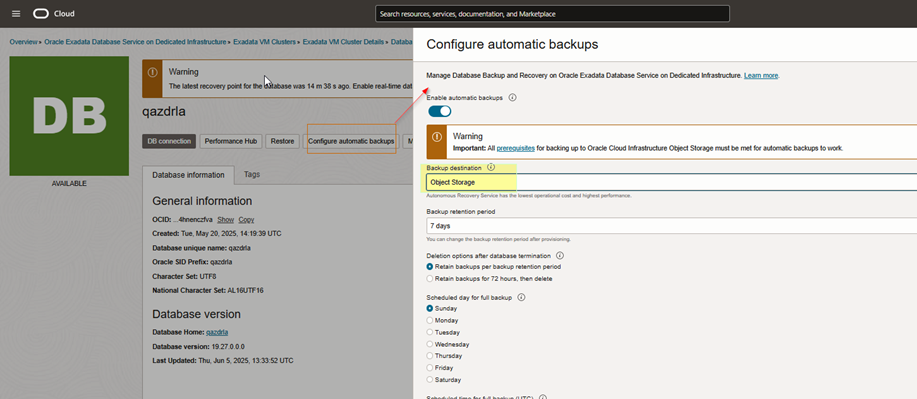
Configure Automatic Backups

  1. Click Configure Automatic Backups.
  2. If the database is currently configured to use Object Storage, it will be indicated.

This is where you’ll switch to Autonomous Recovery Service.

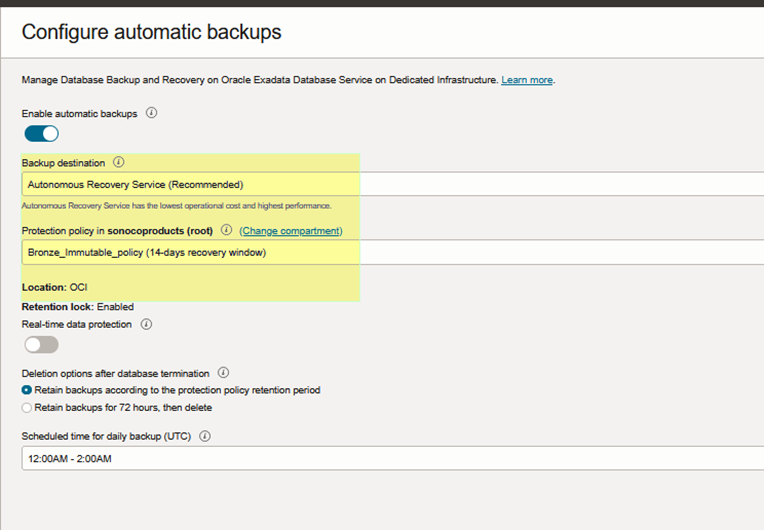
Select Autonomous Recovery Service

Under the backup destination options:

  • Choose Autonomous Recovery Service
  • Select a Custom Retention Policy (recommended for immutability and governance requirements).

NOTE:
Enabling Autonomous Recovery Service will initiate the first backup immediately. The system will then submit a work request to update the database, which may take a couple of hours to complete.

Verification Steps

After enabling the service, verify the backup configuration.

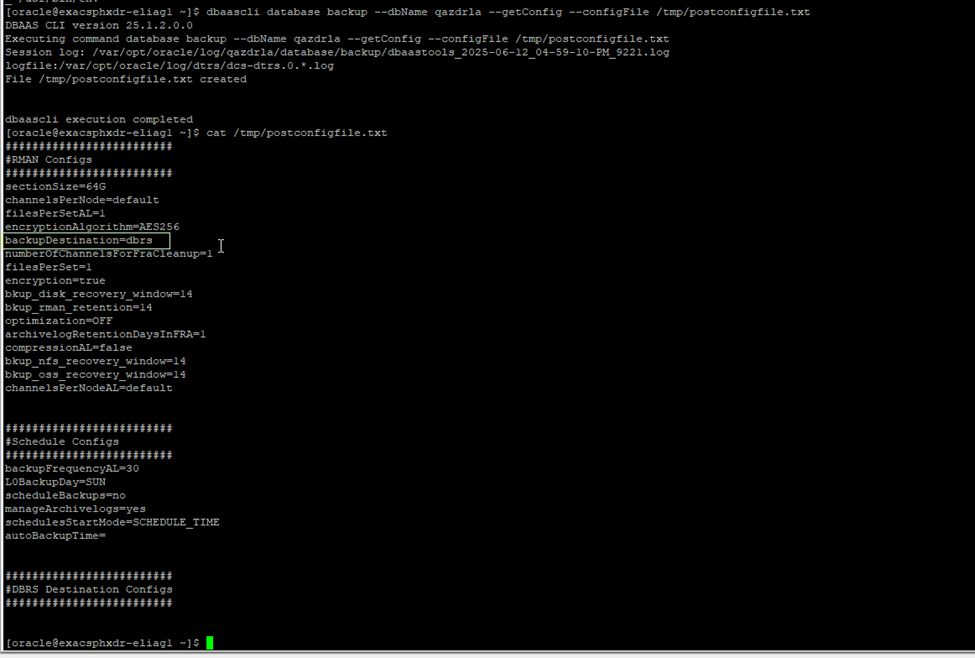
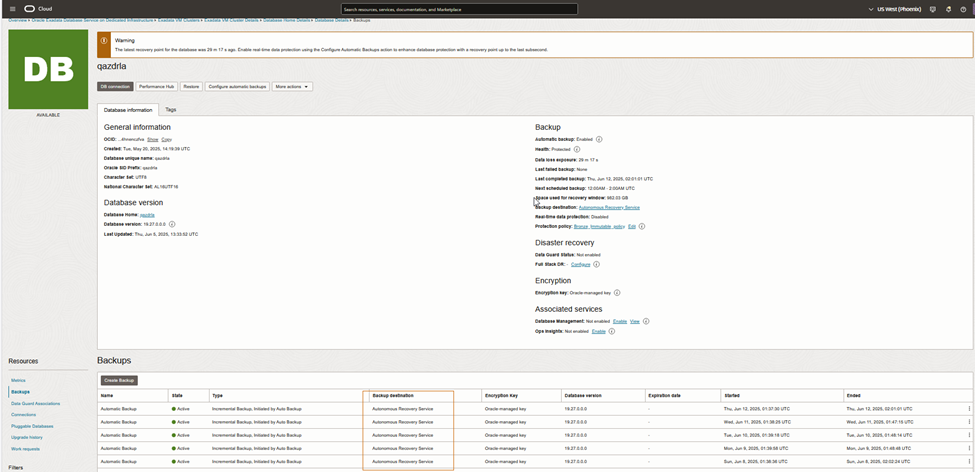
Confirm Backup Destination

Verify that:

  • Backup destination is updated to DBRS (Previously it may have shown: backupDestination=oss)

This confirms the migration from Object Storage to Autonomous Recovery Service.

Verify TNS Entries


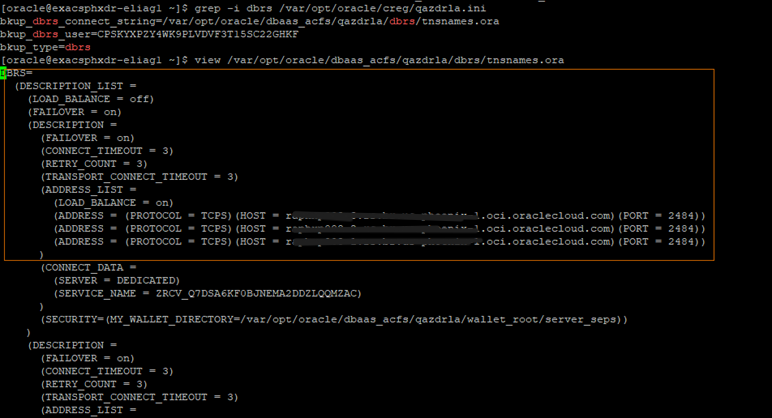
•	Check if new TNS entries are added for ZDRLA appliances.
•	Look for the following in the TNS admin directory:

IFILE=/var/opt/oracle/dbaas_acfs/qazdrla/dbrs/tnsnames.ora


Presence of this file confirms the database is now configured to use ZDLARS connectivity.

Validate Backup Execution

  1. Navigate to the Backups section.
  2. Confirm new backups are completing successfully under Autonomous Recovery Service.

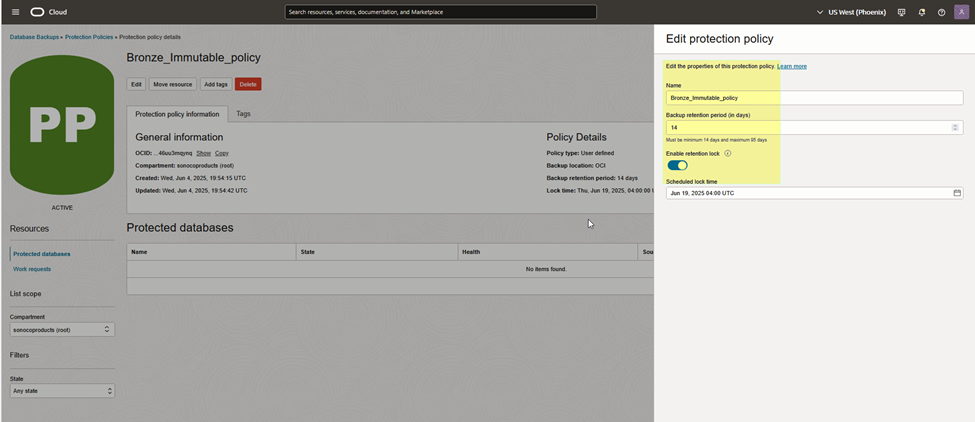
Optional: Enable Retention Lock (Highly Recommended)For enhanced ransomware protection – Immutable Backup

Step 1 – Create a New Backup Policy

  1. Go to Backup Policies
  2. Create a new policy
  3. Enable Retention Lock

Retention Lock ensures:

  • Backups cannot be modified
  • Backups cannot be deleted
  • Protection remains enforced until retention period expires

Step 2 – Apply the Policy

Assign the retention-locked policy to your database backup configuration.

This is especially critical for:

  • Healthcare organizations
  • Financial services
  • Regulated industries
  • Enterprises concerned about insider threats

Why This Matters

Traditional backups protect against hardware failure.
ZDLARS protects against:

  • Ransomware attacks
  • Insider threats
  • Accidental deletion
  • Regulatory non-compliance
  • Data corruption

By separating backup storage into an isolated fault domain and enforcing immutability, Oracle significantly reduces recovery risk.

Final Thoughts

Enabling Zero Data Loss Autonomous Recovery Service is one of the most impactful security upgrades you can implement in OCI for Oracle databases. It transforms backup from a passive safety measure into an active cyber-resilience strategy.

If you’re managing production workloads in OCI, especially mission-critical systems, this configuration should be part of your standard database hardening checklist.

Source

Overview of Oracle Database Autonomous Recovery ServiceZero Data Loss Recovery | OracleIntroducing the Oracle Database Zero Data Loss Autonomous Recovery Service

Understanding Oracle Fusion Cloud Application Maintenance: Quarterly Updates, Monthly Patching, and Exception Patches Explained.

Oracle Fusion Cloud Applications follow a structured and predictable maintenance model designed to balance innovation, stability, and operational continuity. Understanding the differences between quarterly updates, optional monthly patching, and exception patches is critical for effective planning, testing, and risk management. This article provides a practical overview to help IT and business stakeholders navigate Oracle Fusion maintenance with confidence.

Oracle Fusion Maintenance – Quarterly Updates.

Quarterly updates are mandatory for all Oracle Fusion Cloud environments. These updates deliver cumulative content, including:

  • Bug fixes
  • Security patches
  • New features
  • Functional enhancements

Oracle assigns each environment to a quarterly update cohort, which determines when maintenance occurs.

Quarterly Update Cohorts

  • Cohort A: February, May, August, November
  • Cohort B: March, June, September, December
  • Cohort C: April, July, October, January

Stage environments are patched on the first Friday of the update month, followed by production environments on the third Friday, approximately two weeks later. Cohort alignment is especially important to avoid conflicts with internal freeze periods like month-end, quarter-end, or year-end business cycles.

Quarterly updates follow a standardized naming convention (e.g., 24A, 24B), making it easier to track functional and technical changes over time. Quarterly update names combine the year and A, B, C or D. For example, the release for the first quarter of 2023 is 23A; the release for the second quarter of 2023 is 23B; and the release for the first quarter of 2024 will be 24A.


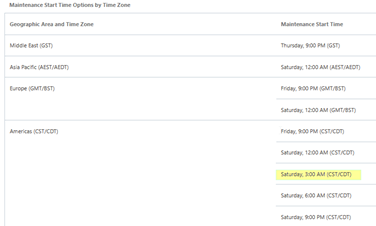
Maintenance start time – Start times are available for the following geographic areas.


Monthly Maintenance Patching: Optional Bug Fixes Between Quarters

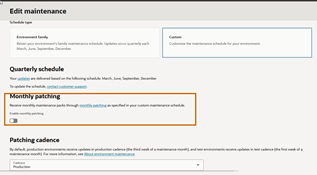
Monthly maintenance packs are optional and deliver bug fixes only, they do not include new features or enhancements. Quarterly updates already contain cumulative fixes. Therefore, monthly patching is disabled by default. It can be enabled in the console if needed under the Edit Maintenance section.

Once enabled, the patches will continue to be delivered each month until Monthly Patching is turned off. Please note that Monthly Patching can be enabled or disabled up to 10 days before the first Friday of the month in which you want the monthly maintenance cycle to start or stop.  Once enabled, Patching is not on demand, it will align with the standard monthly cadence: 1st Friday of the month for stage, 3rd Friday of the month for Production

Oracle recommends enabling monthly patching only when absolutely necessary, like when critical defects can’t wait until the next quarterly update.

Key considerations include:

  • Additional planned outages
  • Increased testing and coordination effort
  • Potential impact to environment refresh schedules
  • Fixed cadence (patching is not on demand)

Exception Patches: Targeted Fixes for Critical Issues

Besides quarterly updates and monthly maintenance packs, Oracle provides Fusion Exception Patches for critical or high-impact issues that require immediate remediation.

Exception patches are:

  • Issued outside the standard quarterly or monthly maintenance cycle
  • Targeted and issue-specific, addressing a defined defect or risk
  • Typically applied only when Oracle determines the issue is severe, like data corruption, security vulnerabilities, or significant business disruption

Unlike monthly patching, exception patches are:

  • Not customer-initiated or scheduled on demand
  • Delivered at Oracle’s discretion after validation and approval
  • Often applied during a separate, Oracle-coordinated maintenance window

Because exception patches fall outside the regular cadence, they may require:

  • Expedited testing
  • Additional stakeholder communication
  • Close coordination between Oracle Support and customer IT teams

Exception patches are generally documented through Oracle Support (SRs and KB notes) and may later be included in a future quarterly update as part of cumulative fixes.


Maintenance Timing and Notifications

Oracle provides automated email notifications to ensure customers are informed about all maintenance-related activities, including:

  • 30 days before maintenance
  • 7 days before maintenance
  • Completion of maintenance
  • Any extensions, rescheduling, or cancellations

For customers in the Americas region, maintenance typically begins at 3:00 AM CST, minimizing business impact while maintaining consistency.


Environment Refresh Rules and Restrictions

Oracle enforces strict rules around environment refreshes to protect system integrity:

  • Source and target environments must be on the same patch level
  • A target environment can only be refreshed once every 7 days
  • Refreshes are restricted:
    • Within 5 days before maintenance
    • 1 day after maintenance begins
    • Between environments with different maintenance dates
  • Maintenance policy changes are restricted 10 days before maintenance

Enabling monthly patching or applying exception patches may further limit available refresh windows, requiring rescheduling of planned activities.


Functional Freeze Before Maintenance

Seventy-two hours prior to maintenance, Oracle restricts updates to certain predefined setup data. During this period, users attempting restricted changes will receive a message indicating that predefined data cannot be updated during application maintenance. This functional freeze ensures a stable baseline for maintenance execution.


Planning for Success

Successfully managing Oracle Fusion maintenance requires coordination across IT, business, and Oracle Support. Best practices include:

  • Selecting the appropriate quarterly cohort to align with business calendars
  • Limiting monthly patching to high-need scenarios
  • Understanding the role and impact of exception patches
  • Planning testing cycles around stage and production timelines
  • Accounting for refresh and functional freeze restrictions

By proactively managing quarterly updates, monthly patching, and exception patches, organizations can minimize risk, maintain system stability, and fully leverage the ongoing innovation delivered through Oracle Fusion Cloud Applications.


Reference documents:

Understanding Environment Maintenance – https://docs.oracle.com/en-us/iaas/Content/fusion-applications/plan-environment-family.htm#about-env-maintenance

Oracle Fusion Cloud Applications Suite Known Issues and Maintenance Packs KB170336

Oracle Applications Cloud – Fusion Applications Update Policy KB160632

Useful Blogs:

Oracle EBS Zero-Day Vulnerabilities: What You Need to Know About Recent CVE’s

Oracle issued two critical vulnerabilities in September 2025, CVE-2025-61882 and CVE-2025-61884. Affecting Oracle E-Business Suite (EBS). These vulnerabilities have been actively exploited in the wild, impacting organizations such as Harvard University and American Airlines’ subsidiary, Envoy Air.

CVE-2025-61882 may impact BI/Analytics Publisher functionality.
CVE-2025-61884 can be mitigated further by disabling Oracle Configurator if unused.

Mitigation:
Refer to MOS documents 3106344.1 and 3107176.1 for detailed patching and mitigation steps.

Risk Assessment:
While both vulnerabilities are critical, environments not exposed externally have a reduced immediate risk. Nevertheless, the recent breaches highlight the importance of timely patching and vigilant monitoring.

Threat Actor:
The Cl0p ransomware group has claimed responsibility for exploiting these vulnerabilities, leading to data breaches at several organizations. For instance, over 1.3 TB of data allegedly stolen from Harvard was posted on the Cl0p data leak website

Summary of the Oracle EBS patches and mitigations for CVE-2025-61882 and CVE-2025-61884.


CVE-2025-61882 – Oracle EBS
Affected Releases: 12.1.3, 12.2

Release 12.2:

  • Apply Patch 38501230:R12.TXK.C and Patch 38501349:R12.CAC.C (hotpatch mode).
  • Stop and restart Oracle EBS.
  • Apply Patch 38501757:R12.XDO.C (hotpatch mode).
  • If ojspCompile.pl errors occur, apply Patch 38502365:R12.TXK.C (hotpatch mode).

Release 12.1.3:

  • Apply Patch 38501376:R12.TXK.B and Patch 38501349:R12.CAC.B (hotpatch mode).
  • Stop and restart Oracle EBS.
  • Apply Patch 38501757:R12.XDO.B (hotpatch mode).

Note: BI/Analytics Publisher functionality (create, copy, preview templates) will be impacted.

Workaround: Use “Moving Templates and Data Definitions Between E-Business Suite Instances” in the Oracle XML Publisher guide. https://docs.oracle.com/cd/B34956_01/current/acrobat/120xdoig.pdf

CVE-2025-61884 – Oracle EBS
Affected Releases: 12.1.3, 12.2

Release 12.2:

  • Apply Patch 38512809:R12.CZ.C and Patch 37614922:R12.IES.C.

Release 12.1.3:

  • Apply Patch 38512809:R12.CZ.B and Patch 37614922:R12.IES.B.

Optional Mitigation:

Disable Oracle Configurator if not in use:

Perform the following steps using the Functional Administrator responsibility:

  1. Go to the Management by Product Hierarchy tab.
  2. In the left panel under the Order Management & Logistics product family, click Configurator.
  3. In the right panel under the Details region, deselect the Enable checkbox.
  4. Click Apply.

Oracle Autonomous Database Updated to 26AI

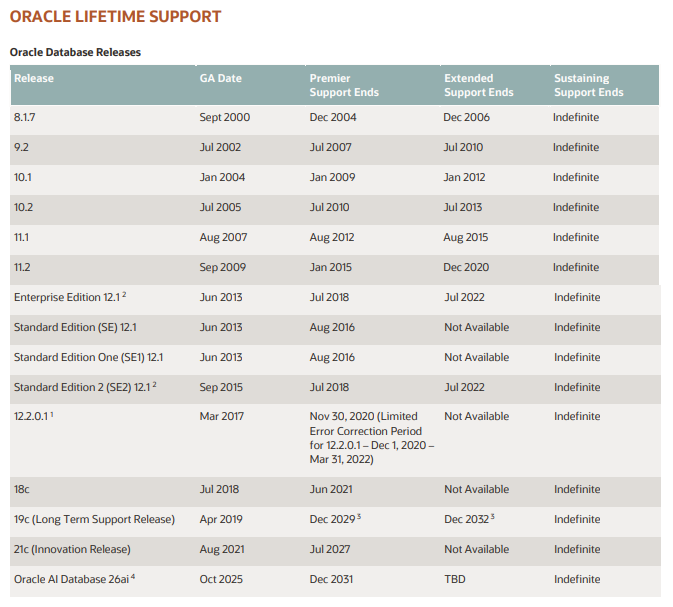
We recently noticed that our Autonomous Database, previously on Oracle Database 23AI, has been updated to Oracle Database 26AI. There was no prior announcement or notification regarding this change.

After reviewing Oracle’s documentation, it appears that 26AI is an incremental update rather than a major version upgrade. Unlike traditional releases, this version adds new AI capabilities on top of Oracle Database 23AI without altering the internal architecture or existing APIs.

As a result, there is no need for application re-certification or complex upgrade steps—the transition is seamless.

Update path summary:

  • Oracle Database 19c → 26AI (requires full upgrade)
  • Oracle Database 21c → 26AI (requires full upgrade)
  • Oracle Database 23AI → 26AI (applies October Release Update)

Essentially, for customers already on Oracle Database 23ai, the transition to 26ai is simple: just apply the October 2025 release update. No major architecture change, no application recertification required. It retains full mission-critical database capabilities, transactional, operational, analytic workloads and can run across environments (Oracle Cloud, other hyperscale clouds, private cloud, on-premises).

Oracle AI Database 26ai announcement: Oracle introduces its AI-native database, Oracle AI Database 26ai

For more detailed information on bug fix and patch release policies and dates, please refer to the Database Error Correction
Support Policy (Doc ID 209768.1) and the Release Schedule of Current Database Releases (Doc ID 742060.1)
Information on upgrade paths can be found in the Database Upgrade Guide for the release you plan to upgrade to. Product
documentation can be found at https://docs.oracle.com in the Oracle Help Center

WebLogic/Node Manager Server startup is very slow on Linux

Started WebLogic (startWebLogic.sh) and it took close to 20 minutes to start and 15 minutes to start node manager. Came across below MOS document that helped resolve the issue. The slowness was due to depletion of the entropy pool provided by the OS. We need at least 500 for WebLogic.

Entropy is randomness from keyboard timings, mouse movements, and IDE timings and makes the random character data available to OS system processes through the /dev/random and /dev/urandom When there is not enough random bits left it will block and the process that are reading from it will hang until bits that are more random has been generated.

Monitoring entropy

The default size of the entropy pool is 4096 bits. You can see the size here.

[oracle@ussvr137 ~]$ cat /proc/sys/kernel/random/poolsize

4096

You can see how much entropy is available via:

[oracle@ussvr137 ~]$ cat /proc/sys/kernel/random/entropy_avail

2136

Or use watch if you want to display it every second:

watch -n 1 cat /proc/sys/kernel/random/entropy_avail

If you monitor with watch during WebLogic startup, you can check to see if entropy gets drained on the server for entropy.

Solution available in the following MOS notes.

How to diagnose a Linux entropy issue on WebLogic Server instances? (Doc ID 1574979.1)

Integrated WebLogic Server startup is very slow on Linux (Doc ID 1997349.1)

E1: OS: Linux Servers Hang or Have Delays on Any JAVA Process Affecting Performance (Doc ID 1525645.1

Linux command line reference for common operations.

Command Description
  apropos whatis Show commands pertinent to string. See also threadsafe
  man -t ascii | ps2pdf – > ascii.pdf make a pdf of a manual page
  which command Show full path name of command
  time command See how long a command takes
  time cat Start stopwatch. Ctrl-d to stop. See also sw
dir navigation
  cd – Go to previous directory
  cd Go to $HOME directory
  (cd dir && command) Go to dir, execute command and return to current dir
  pushd . Put current dir on stack so you can popd back to it
  alias l=’ls -l –color=auto’ quick dir listing. See also l
  ls -lrt List files by date. See also newest and find_mm_yyyy
  ls /usr/bin | pr -T9 -W$COLUMNS Print in 9 columns to width of terminal
  find -name ‘*.[ch]’ | xargs grep -E ‘expr’ Search ‘expr’ in this dir and below. See also findrepo
  find -type f -print0 | xargs -r0 grep -F ‘example’ Search all regular files for ‘example’ in this dir and below
  find -maxdepth 1 -type f | xargs grep -F ‘example’ Search all regular files for ‘example’ in this dir
  find -maxdepth 1 -type d | while read dir; do echo $dir; echo cmd2; done Process each item with multiple commands (in while loop)
  find -type f ! -perm -444 Find files not readable by all (useful for web site)
  find -type d ! -perm -111 Find dirs not accessible by all (useful for web site)
  locate -r ‘file[^/]*\.txt’ Search cached index for names. This re is like glob *file*.txt
  look reference Quickly search (sorted) dictionary for prefix
  grep –color reference /usr/share/dict/words Highlight occurances of regular expression in dictionary
archives and compression
  gpg -c file Encrypt file
  gpg file.gpg Decrypt file
  tar -c dir/ | bzip2 > dir.tar.bz2 Make compressed archive of dir/
  bzip2 -dc dir.tar.bz2 | tar -x Extract archive (use gzip instead of bzip2 for tar.gz files)
  tar -c dir/ | gzip | gpg -c | ssh user@remote ‘dd of=dir.tar.gz.gpg’ Make encrypted archive of dir/ on remote machine
  find dir/ -name ‘*.txt’ | tar -c –files-from=- | bzip2 > dir_txt.tar.bz2 Make archive of subset of dir/ and below
  find dir/ -name ‘*.txt’ | xargs cp -a –target-directory=dir_txt/ –parents Make copy of subset of dir/ and below
  ( tar -c /dir/to/copy ) | ( cd /where/to/ && tar -x -p ) Copy (with permissions) copy/ dir to /where/to/ dir
  ( cd /dir/to/copy && tar -c . ) | ( cd /where/to/ && tar -x -p ) Copy (with permissions) contents of copy/ dir to /where/to/
  ( tar -c /dir/to/copy ) | ssh -C user@remote ‘cd /where/to/ && tar -x -p’ Copy (with permissions) copy/ dir to remote:/where/to/ dir
  dd bs=1M if=/dev/sda | gzip | ssh user@remote ‘dd of=sda.gz’ Backup harddisk to remote machine
rsync (Network efficient file copier: Use the –dry-run option for testing)
  rsync -P rsync://rsync.server.com/path/to/file file Only get diffs. Do multiple times for troublesome downloads
  rsync –bwlimit=1000 fromfile tofile Locally copy with rate limit. It’s like nice for I/O
  rsync -az -e ssh –delete ~/public_html/ remote.com:’~/public_html’ Mirror web site (using compression and encryption)
  rsync -auz -e ssh remote:/dir/ . && rsync -auz -e ssh . remote:/dir/ Synchronize current directory with remote one
ssh (Secure SHell)
  ssh $USER@$HOST command Run command on $HOST as $USER (default command=shell)
  ssh -f -Y $USER@$HOSTNAME xeyes Run GUI command on $HOSTNAME as $USER
  scp -p -r $USER@$HOST: file dir/ Copy with permissions to $USER’s home directory on $HOST
  scp -c arcfour $USER@$LANHOST: bigfile Use faster crypto for local LAN. This might saturate GigE
  ssh -g -L 8080:localhost:80 root@$HOST Forward connections to $HOSTNAME:8080 out to $HOST:80
  ssh -R 1434:imap:143 root@$HOST Forward connections from $HOST:1434 in to imap:143
  ssh-copy-id $USER@$HOST Install public key for $USER@$HOST for password-less log in
wget (multi purpose download tool)
  (cd dir/ && wget -nd -pHEKk http://www.example.com/file) Store local browsable version of a page to the current dir
  wget -c http://www.example.com/large.file Continue downloading a partially downloaded file
  wget -r -nd -np -l1 -A ‘*.jpg’ http://www.example.com/dir/ Download a set of files to the current directory
  wget ftp://remote/file[1-9].iso/ FTP supports globbing directly
  wget -q -O- http://www.example/file | grep ‘a href’ | head Process output directly
  echo ‘wget url’ | at 01:00 Download url at 1AM to current dir
  wget –limit-rate=20k url Do a low priority download (limit to 20KB/s in this case)
  wget -nv –spider –force-html -i bookmarks.html Check links in a file
  wget –mirror http://www.example.com/ Efficiently update a local copy of a site (handy from cron)
networking (Note ifconfig, route, mii-tool, nslookup commands are obsolete)
  ethtool eth0 Show status of ethernet interface eth0
  ethtool –change eth0 autoneg off speed 100 duplex full Manually set ethernet interface speed
  iw dev wlan0 link Show link status of wireless interface wlan0
  iw dev wlan0 set bitrates legacy-2.4 1 Manually set wireless interface speed
  iw dev wlan0 scan List wireless networks in range
  ip link show List network interfaces
  ip link set dev eth0 name wan Rename interface eth0 to wan
  ip link set dev eth0 up Bring interface eth0 up (or down)
  ip addr show List addresses for interfaces
  ip addr add 1.2.3.4/24 brd + dev eth0 Add (or del) ip and mask (255.255.255.0)
  ip route show List routing table
  ip route add default via 1.2.3.254 Set default gateway to 1.2.3.254
  ss -tupl List internet services on a system
  ss -tup List active connections to/from system
  host pixelbeat.org Lookup DNS ip address for name or vice versa
  hostname -i Lookup local ip address (equivalent to host `hostname`)
  whois pixelbeat.org Lookup whois info for hostname or ip address
windows networking (Note samba is the package that provides all this windows specific networking support)
  smbtree Find windows machines. See also findsmb
  nmblookup -A 1.2.3.4 Find the windows (netbios) name associated with ip address
  smbclient -L windows_box List shares on windows machine or samba server
  mount -t smbfs -o fmask=666,guest //windows_box/share /mnt/share Mount a windows share
  echo ‘message’ | smbclient -M windows_box Send popup to windows machine (off by default in XP sp2)
text manipulation (Note sed uses stdin and stdout. Newer versions support inplace editing with the -i option)
  sed ‘s/string1/string2/g’ Replace string1 with string2
  sed ‘s/\(.*\)1/\12/g’ Modify anystring1 to anystring2
  sed ‘/^ *#/d; /^ *$/d’ Remove comments and blank lines
  sed ‘:a; /\\$/N; s/\\\n//; ta’ Concatenate lines with trailing \
  sed ‘s/[ \t]*$//’ Remove trailing spaces from lines
  sed ‘s/\([`”$\]\)/\\\1/g’ Escape shell metacharacters active within double quotes
  seq 10 | sed “s/^/      /; s/ *\(.\{7,\}\)/\1/” Right align numbers
  seq 10 | sed p | paste – – Duplicate a column
  sed -n ‘1000{p;q}’ Print 1000th line
  sed -n ‘10,20p;20q’ Print lines 10 to 20
  sed -n ‘s/.*<title>\(.*\)<\/title>.*/\1/ip;T;q’ Extract title from HTML web page
  sed -i 42d ~/.ssh/known_hosts Delete a particular line
  sort -t. -k1,1n -k2,2n -k3,3n -k4,4n Sort IPV4 ip addresses
  echo ‘Test’ | tr ‘[:lower:]’ ‘[:upper:]’ Case conversion
  tr -dc ‘[:print:]’ < /dev/urandom Filter non printable characters
  tr -s ‘[:blank:]’ ‘\t’ </proc/diskstats | cut -f4 cut fields separated by blanks
  history | wc -l Count lines
  seq 10 | paste -s -d ‘ ‘ Concatenate and separate line items to a single line
set operations (Note you can export LANG=C for speed. Also these assume no duplicate lines within a file)
  sort -u file1 file2 Union of unsorted files
  sort file1 file2 | uniq -d Intersection of unsorted files
  sort file1 file1 file2 | uniq -u Difference of unsorted files
  sort file1 file2 | uniq -u Symmetric Difference of unsorted files
  join -t’\0′ -a1 -a2 file1 file2 Union of sorted files
  join -t’\0′ file1 file2 Intersection of sorted files
  join -t’\0′ -v2 file1 file2 Difference of sorted files
  join -t’\0′ -v1 -v2 file1 file2 Symmetric Difference of sorted files
math
  echo ‘(1 + sqrt(5))/2’ | bc -l Quick math (Calculate φ). See also bc
  seq -f ‘4/%g’ 1 2 99999 | paste -sd-+ | bc -l Calculate π the unix way
  echo ‘pad=20; min=64; (100*10^6)/((pad+min)*8)’ | bc More complex (int) e.g. This shows max FastE packet rate
  echo ‘pad=20; min=64; print (100E6)/((pad+min)*8)’ | python Python handles scientific notation
  echo ‘pad=20; plot [64:1518] (100*10**6)/((pad+x)*8)’ | gnuplot -persist Plot FastE packet rate vs packet size
  echo ‘obase=16; ibase=10; 64206’ | bc Base conversion (decimal to hexadecimal)
  echo $((0x2dec)) Base conversion (hex to dec) ((shell arithmetic expansion))
  units -t ‘100m/9.58s’ ‘miles/hour’ Unit conversion (metric to imperial)
  units -t ‘500GB’ ‘GiB’ Unit conversion (SI to IEC prefixes). See also numfmt
  units -t ‘1 googol’ Definition lookup
  seq 100 | paste -s -d+ | bc Add a column of numbers. See also add and funcpy
calendar
  cal -3 Display a calendar
  cal 9 1752 Display a calendar for a particular month year
  date -d fri What date is it this friday. See also day
  [ $(date -d ’12:00 today +1 day’ +%d) = ’01’ ] || exit exit a script unless it’s the last day of the month
  date –date=’25 Dec’ +%A What day does xmas fall on, this year
  date –date=’@2147483647′ Convert seconds since the epoch (1970-01-01 UTC) to date
  TZ=’America/Los_Angeles’ date What time is it on west coast of US (use tzselect to find TZ)
  date –date=’TZ=”America/Los_Angeles” 09:00 next Fri’ What’s the local time for 9AM next Friday on west coast US
locales
  printf “%’d\n” 1234 Print number with thousands grouping appropriate to locale
  BLOCK_SIZE=\’1 ls -l Use locale thousands grouping in ls. See also l
  echo “I live in `locale territory`” Extract info from locale database
  LANG=en_IE.utf8 locale int_prefix Lookup locale info for specific country. See also ccodes
  locale -kc $(locale | sed -n ‘s/\(LC_.\{4,\}\)=.*/\1/p’) | less List fields available in locale database
recode (Obsoletes iconv, dos2unix, unix2dos)
  recode -l | less Show available conversions (aliases on each line)
  recode windows-1252.. file_to_change.txt Windows “ansi” to local charset (auto does CRLF conversion)
  recode utf-8/CRLF.. file_to_change.txt Windows utf8 to local charset
  recode iso-8859-15..utf8 file_to_change.txt Latin9 (western europe) to utf8
  recode ../b64 < file.txt > file.b64 Base64 encode
  recode /qp.. < file.qp > file.txt Quoted printable decode
  recode ..HTML < file.txt > file.html Text to HTML
  recode -lf windows-1252 | grep euro Lookup table of characters
  echo -n 0x80 | recode latin-9/x1..dump Show what a code represents in latin-9 charmap
  echo -n 0x20AC | recode ucs-2/x2..latin-9/x Show latin-9 encoding
  echo -n 0x20AC | recode ucs-2/x2..utf-8/x Show utf-8 encoding
CDs
  gzip < /dev/cdrom > cdrom.iso.gz Save copy of data cdrom
  mkisofs -V LABEL -r dir | gzip > cdrom.iso.gz Create cdrom image from contents of dir
  mount -o loop cdrom.iso /mnt/dir Mount the cdrom image at /mnt/dir (read only)
  wodim dev=/dev/cdrom blank=fast Clear a CDRW
  gzip -dc cdrom.iso.gz | wodim -tao dev=/dev/cdrom -v -data – Burn cdrom image (use –prcap to confirm dev)
  cdparanoia -B Rip audio tracks from CD to wav files in current dir
  wodim -v dev=/dev/cdrom -audio -pad *.wav Make audio CD from all wavs in current dir (see also cdrdao)
  oggenc –tracknum=$track track.cdda.wav -o track.ogg Make ogg file from wav file
disk space (See also FSlint)
  ls -lSr Show files by size, biggest last
  du -s * | sort -k1,1rn | head Show top disk users in current dir. See also dutop
  du -hs /home/* | sort -k1,1h Sort paths by easy to interpret disk usage
  df -h Show free space on mounted filesystems
  df -i Show free inodes on mounted filesystems
  fdisk -l Show disks partitions sizes and types (run as root)
  rpm -q -a –qf ‘%10{SIZE}\t%{NAME}\n’ | sort -k1,1n List all packages by installed size (Bytes) on rpm distros
  dpkg-query -W -f=’${Installed-Size;10}\t${Package}\n’ | sort -k1,1n List all packages by installed size (KBytes) on deb distros
  dd bs=1 seek=2TB if=/dev/null of=ext3.test Create a large test file (taking no space). See also truncate
  > file truncate data of file or create an empty file
monitoring/debugging
  tail -f /var/log/messages Monitor messages in a log file
  strace -c ls >/dev/null Summarise/profile system calls made by command
  strace -f -e open ls >/dev/null List system calls made by command
  strace -f -e trace=write -e write=1,2 ls >/dev/null Monitor what’s written to stdout and stderr
  ltrace -f -e getenv ls >/dev/null List library calls made by command
  lsof -p $$ List paths that process id has open
  lsof ~ List processes that have specified path open
  tcpdump not port 22 Show network traffic except ssh. See also tcpdump_not_me
  ps -e -o pid,args –forest List processes in a hierarchy
  ps -e -o pcpu,cpu,nice,state,cputime,args –sort pcpu | sed ‘/^ 0.0 /d’ List processes by % cpu usage
  ps -e -orss=,args= | sort -b -k1,1n | pr -TW$COLUMNS List processes by mem (KB) usage. See also ps_mem.py
  ps -C firefox-bin -L -o pid,tid,pcpu,state List all threads for a particular process
  ps -p 1,$$ -o etime= List elapsed wall time for particular process IDs
  watch -n.1 pstree -Uacp $$ Display a changing process subtree
  last reboot Show system reboot history
  free -m Show amount of (remaining) RAM (-m displays in MB)
  watch -n.1 ‘cat /proc/interrupts’ Watch changeable data continuously
  udevadm monitor Monitor udev events to help configure rules
system information (see also sysinfo) (‘#’ means root access is required)
  uname -a Show kernel version and system architecture
  head -n1 /etc/issue Show name and version of distribution
  cat /proc/partitions Show all partitions registered on the system
  grep MemTotal /proc/meminfo Show RAM total seen by the system
  grep “model name” /proc/cpuinfo Show CPU(s) info
  lspci -tv Show PCI info
  lsusb -tv Show USB info
  mount | column -t List mounted filesystems on the system (and align output)
  grep -F capacity: /proc/acpi/battery/BAT0/info Show state of cells in laptop battery
  dmidecode -q | less Display SMBIOS/DMI information
  smartctl -A /dev/sda | grep Power_On_Hours How long has this disk (system) been powered on in total
  hdparm -i /dev/sda Show info about disk sda
  hdparm -tT /dev/sda Do a read speed test on disk sda
  badblocks -s /dev/sda Test for unreadable blocks on disk sda
interactive (see also linux keyboard shortcuts)
  readline Line editor used by bash, python, bc, gnuplot, …
  screen Virtual terminals with detach capability, …
  mc Powerful file manager that can browse rpm, tar, ftp, ssh, …
  gnuplot Interactive/scriptable graphing
  links Web browser
  xdg-open . open a file or url with the registered desktop application